Warmly lit timber-frame and stone houses line a street at dusk, with evergreen trees and a snow-capped mountain range in the background.

Heat Pump Repair in Alamosa, CO

Tell us about the job

Takes about a minute. No obligation.

Step 1 of 3: Equipment

Cold nights make the heat pump work harder

Alamosa winters average around 8°F overnight in December, January and February. A heat pump pulls heat from outside air, so on those cold nights it leans on the backup heat strip more than it does in milder weather. That's normal operation, not a sign of damage.

Most calls come down to a known cause

When a heat pump stops keeping up here, the reason is usually something a tech sees often. A dirty filter. Low refrigerant. A failing defrost sensor. A contactor worn out from regular cycling. Finding which one it is tells you whether the fix is quick or bigger.

9 months
September through May, your system heats
8°F
the average winter night it heats against
80°F
the average summer afternoon it cools against
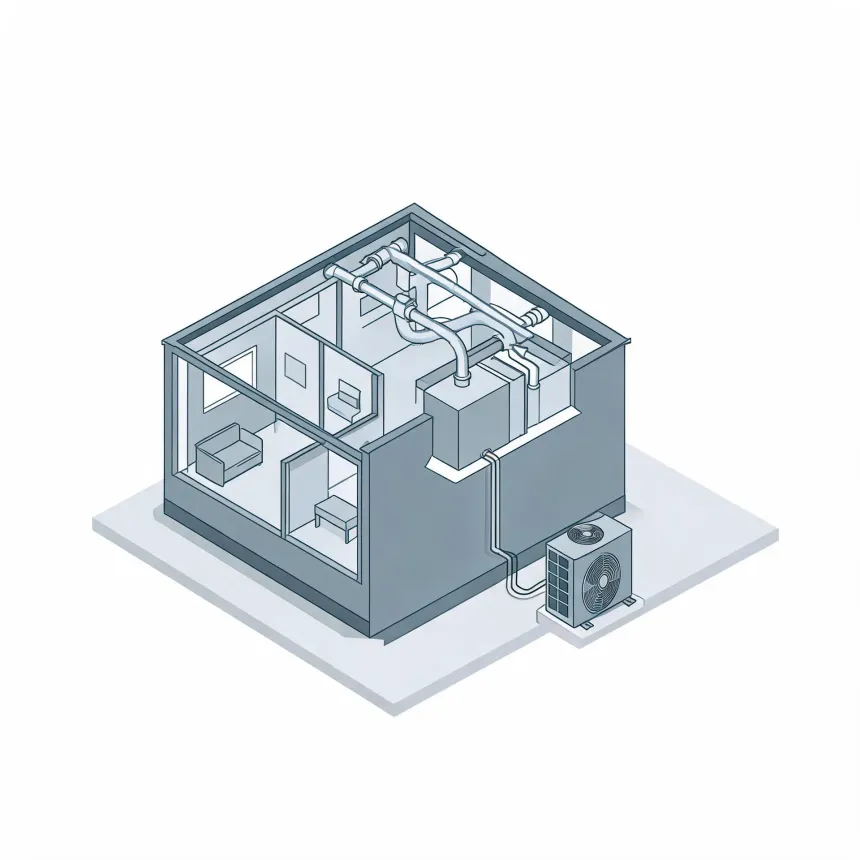
Isometric line illustration of a cutaway house showing interior rooms with furniture, ceiling ductwork connected to an indoor air handler, and refrigerant lines running to an outdoor condenser unit on a pad.

Heat pumps in Alamosa County run September through May.

The first cold snap in September is when a weak part finally gives out.

Electricity here runs 14.92 cents a kWh, and a heat pump limping along burns more of it every day you wait

Power costs 14.92 cents a kWh statewide
Climate zone 6B
Heat runs September through May
A heat pump that's struggling costs you every day it runsColorado's electricity ran 14.92 cents a kWh in 2024

Half the homes in Alamosa County were built in 1982 or later. If yours is one of them, your heat pump probably isn't old enough to be failing on its own. A unit that came with a newer build usually still has years of working life left, and at that age a problem almost always traces back to one worn part, not the whole system. That's worth knowing before anyone brings up replacement. Mobile homes are part of the housing mix here too, and a heat pump in one works the same as in any other home, same parts, same fixes.

A newer system is worth repairing, not replacing

A newer heat pump acting up is almost always a repair, not a replacement. Get the part that's failing diagnosed and fixed before it takes anything else with it.

Find a contractor
A gray heat pump condenser unit mounted on a concrete pad against the gray lap-siding exterior wall of a house.

The parts that work hardest are the parts that fail

A heat pump cycles on and off all day, every day it's in season, and the parts that fail are the ones doing the most work. The contactor makes and breaks power to the outdoor unit every time it starts, and the contacts wear down until they pit or stick. The run capacitor holds a charge to keep the compressor and fan motors turning steadily, and it loses capacity over years until the motor struggles to start. The defrost sensor and board manage the switch between heating and defrost cycles, and when that sensor drifts or the board sticks, the unit can freeze up outside or short-cycle trying to clear frost that isn't there. Bearings in the outdoor fan motor wear from constant turning, and a motor that's starting to go sounds like it before it quits. None of this means the whole system is at the end of its life. It's almost always one of these parts wearing out on its own schedule, not the compressor or the unit itself.

What you'll notice first

The heat pump runs but the air coming out doesn't feel warm, or it runs constantly without the house catching up to the thermostat. Sometimes it blows cold air outright. Outside, the unit might ice over and stay that way instead of clearing itself during the normal defrost cycle. You may hear it cycling on and off faster than usual, or notice the outdoor fan isn't spinning even though the unit sounds like it's trying to run.

What those signs are telling you

Warm air that isn't warm enough usually points to refrigerant charge or a failing reversing valve, the part that switches the system between heating and cooling. Ice that won't clear means the defrost sensor or board isn't doing its job. A fan that won't spin is often a seized motor or a bad capacitor, not something wrong with the whole system. Each symptom narrows down to a specific part, which is why calling out what you're seeing, not just that something's wrong, gets the right fix faster.

A heat pump that's struggling doesn't fail faster just by running, but what's already wrong with it gets worse. Ice that isn't clearing spreads across more of the outdoor coil the longer the unit keeps cycling, and a coil caked in ice can't pull heat from the air at all, so the system leans harder on backup heat to compensate. A contactor with pitted contacts arcs a little more each time it closes, until it sticks or fails to close at all. A compressor starting on a weak capacitor draws more current than it should every time it tries, and that heat builds up in the motor windings over repeated starts. None of these get better on their own. The part that's struggling is doing the same job every cycle, under worse conditions than the last one, until it's the part that quits.

The question isn't the heat pump's age so much as what's actually failing on it. A system with one bad capacitor or a stuck contactor is a repair, full stop, no matter how long it's been running, because the rest of the unit isn't touched by that part going bad. Replacement starts making sense when the compressor itself is failing, since that's the part that moves refrigerant and does the actual work of heating, and a compressor doesn't get swapped on its own the way a capacitor does. It also makes sense when the same system keeps coming back with a different part failing every season, which usually means the whole unit is wearing out at once rather than one piece giving out early. Short of that, fixing the part that's actually broken is almost always the right call.