Electricity here runs 18.02 cents a kilowatt-hour
That is higher than what most US counties pay. A heat pump runs on electricity for both heating and cooling, so every degree it moves costs more here than it would somewhere with cheaper power.
Takes about a minute. No obligation.
That is higher than what most US counties pay. A heat pump runs on electricity for both heating and cooling, so every degree it moves costs more here than it would somewhere with cheaper power.
With power priced the way it is in Archuleta County, the difference between a heat pump that runs well and one that struggles shows up on every bill it generates, not just the first one.
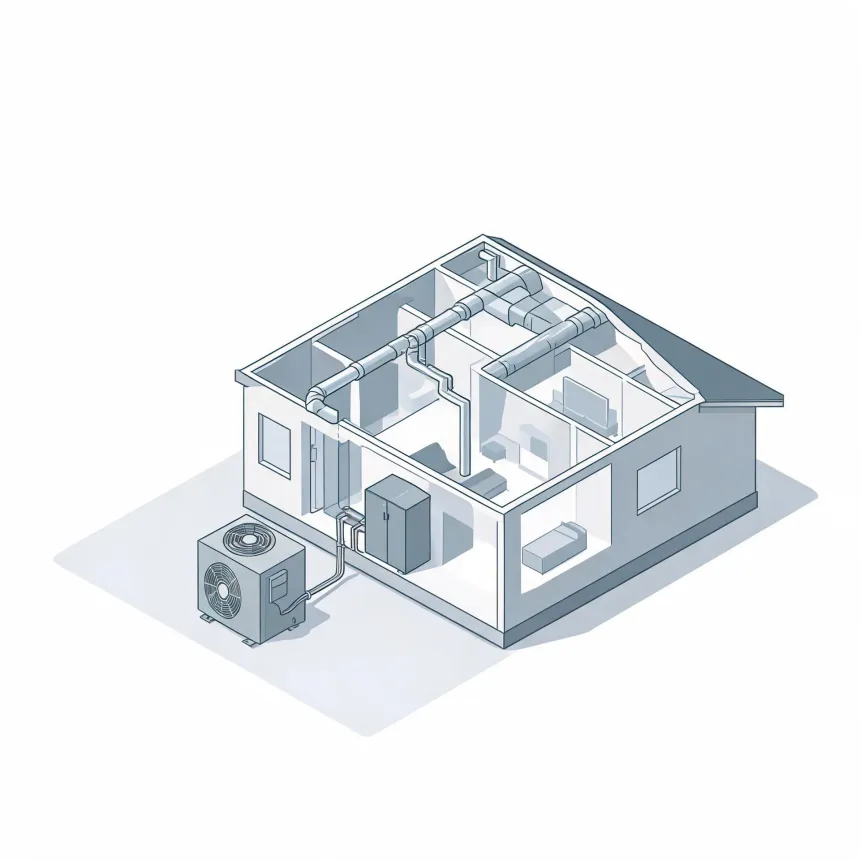
The rated efficiency on paper assumes a properly sized system matched to the right ductwork.
Ask what size unit each bid calls for and what it based that size on, not just the efficiency number on the brochure.




Archuleta County falls under zone 6B in the 2021 energy code, a cold, dry climate with a long heating season. Any split-system heat pump installed here, if manufactured from 2023 onward, has to meet the federal minimum: at least 14.3 Btu of cooling delivered for every watt-hour it draws over the summer, and at least 7.5 Btu of heat for every watt-hour over the winter. That floor rules out the lower end of what a manufacturer might sell in a milder zone. A contractor bidding this job is already working from a narrower list of equipment because of it. Some systems on the market clear that bar by a wide margin, and a federal tax credit is available for those that qualify.
Get the sizing and the equipment right at install and that efficiency number keeps paying you back for as long as the system runs. Get it wrong and you're covering the gap on every bill, in a county where power already costs more than most places pay. Have a contractor walk you through what each bid is actually rated for before you decide.
Find a contractorWhatever is heating this house now doesn't just disappear once the new system goes in. If it's a furnace, most installers will leave it in place as a backup and tie the heat pump in ahead of it, so the furnace only fires when the outdoor temperature drops below where the heat pump can keep up on its own. That setup is called a dual fuel system, and it means the old equipment keeps earning its place in the mechanical room instead of going to the curb. If there's an old central air condenser outside, that one does get hauled away. It can't run alongside a heat pump since the heat pump takes over cooling entirely, and leaving a dead unit sitting next to the new one just invites someone to mistake one for the other down the road. Whatever gets removed should be disposed of by the contractor, refrigerant recovered properly rather than vented, since older systems often held refrigerant that isn't handled the same way anymore. Ask what's staying, what's going, and what the plan is for the parts that stay.
A heat pump sized off a load calculation, room by room and window by window, runs long low-speed cycles that keep the house even. One sized by rule of thumb, or matched to the old furnace's output, ends up too big or too small. Too big and it short-cycles, wearing out parts faster and never running long enough to dehumidify. Too small and it leans on backup heat strips to cover the gap, and those draw a lot more power than the compressor does.
A heat pump moves more air across the coil than a furnace does, and it moves it at lower temperatures, so it needs ducts that can carry that volume without choking it off. Ducts sized for the old gas furnace sometimes can't keep up, and a static pressure test during installation will show whether they can. Skip that check and the new system can be rated well on paper and still struggle to move the air it needs to move.
The efficiency number on a heat pump's label is a lab rating. It tells you how much heat the unit moves for the power it draws under test conditions, not what it will do hanging on the side of this particular house. Two units with the same rating can still perform differently once they're matched to real ductwork and a real load calculation. The rating is a ceiling, not a guarantee. What gets that unit close to its rated number is correct sizing, a clean refrigerant charge, and airflow across the coil that matches what the manufacturer built it to handle. Ask what the installer is doing to get the installed system close to the number on the sticker, because the sticker alone won't do it.
Installation starts with the old equipment coming out, or getting disconnected if it's staying on as backup. Then the outdoor unit goes in on a pad or bracket, the indoor coil gets set, and the line set connecting them gets run, brazed, and pressure tested for leaks before anything gets charged with refrigerant. A good installer pulls a vacuum on those lines first to clear out air and moisture, because either one left behind will damage the compressor over time. Electrical work usually means a dedicated circuit and disconnect box sized for the new unit, which often draws differently than whatever was there before. Once it's charged and powered, the system gets commissioned: refrigerant charge checked against the manufacturer's specification, airflow measured at the coil, and the thermostat or controls programmed and tested through a full heating and cooling cycle. That commissioning step is what separates a unit that's running from a unit that's running right.