




A gravel road curves past dark-sided cabins with metal roofs among tall pine trees, with a rustic split-rail wood fence and grass along the left side.

Heat Pump Repair in Steamboat Springs, CO

Tell us about the job

Takes about a minute. No obligation.

Step 1 of 3: Equipment

August is when to get a heat pump looked at here, right before heat season starts up in September. Homes in Routt County run heat about ten months a year, so a heat pump gets asked to work hard almost as soon as it switches over. A part that was already borderline, a weak capacitor, a low charge, tends to give out in those first cold weeks when the system suddenly has to run long hours. Catching it in August means a contractor can find that weak part while the system is idle, not after it's failed on a cold morning.

10 months
September through June, your system heats
11°F
the average winter night it heats against
74°F
the average summer afternoon it cools against
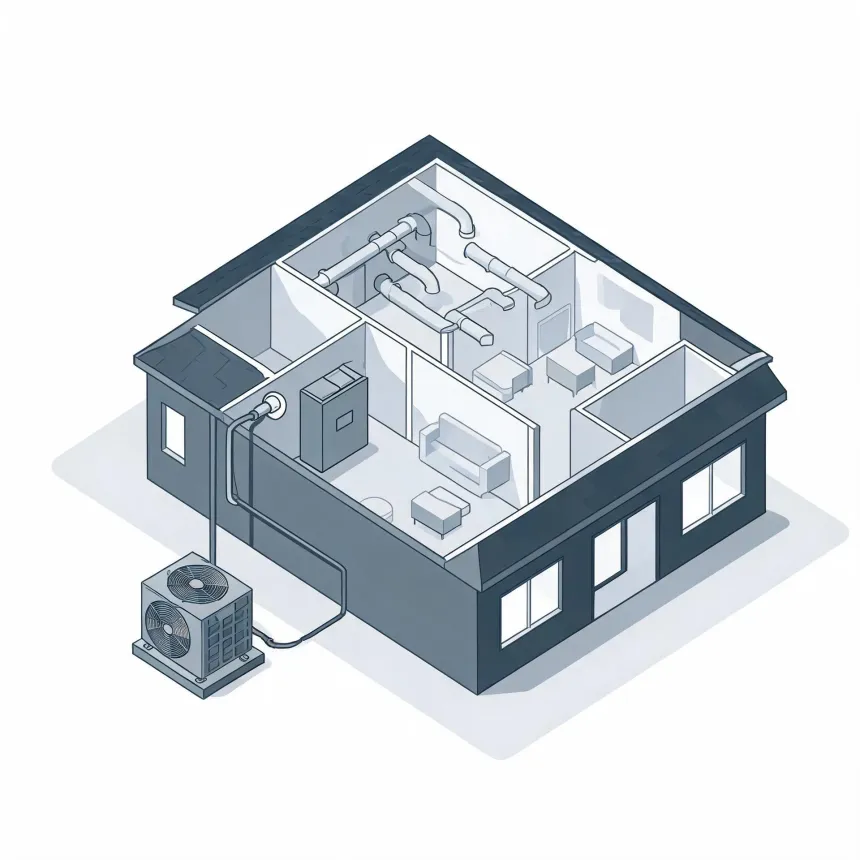
Isometric line illustration of a cutaway single-story house showing interior rooms, ceiling ductwork and an indoor air handler, connected by a line to an outdoor condenser unit on a pad beside the building.

Routt County winters average 11°F overnight, and a heat pump handles that the same way it would in any cold climate.

So when one stops keeping up, look for the part that failed, not the cold outside.

Electricity here runs 14.92 cents a kWh, and a heat pump that's struggling burns more of it every day you wait

Power costs 14.92 cents a kWh statewide
47 damaging wind events from 2015 to 2024
202 winter storms from 2015 to 2024
A younger county, a younger systemHalf the homes in Routt County were built in 1993 or later

Routt County sees winter storms most years, 202 of them between 2015 and 2024, and damaging wind now and then too. None of that is out of the ordinary for a mountain county, and it isn't what's wrong with your heat pump. A system built for this climate is built to take wind and snow. What usually brings one down is simpler. A contactor that's pitted, a capacitor that's weak, a refrigerant charge that's dropped. The weather here didn't cause that. If the power blinked recently it's worth checking for a tripped breaker or a reset button, but if the unit was already struggling before that, the storm just happened to be what you noticed it on.

A newer system is worth fixing

If your heat pump came with the house, there's a good chance it's not old enough to be the problem. A repair is likely to get it back to working the way it did.

Find a contractor
A man in a cap, dark jacket and tan work pants carries a canvas tool bag up concrete steps toward a dark blue front door, with a potted shrub beside the entry.
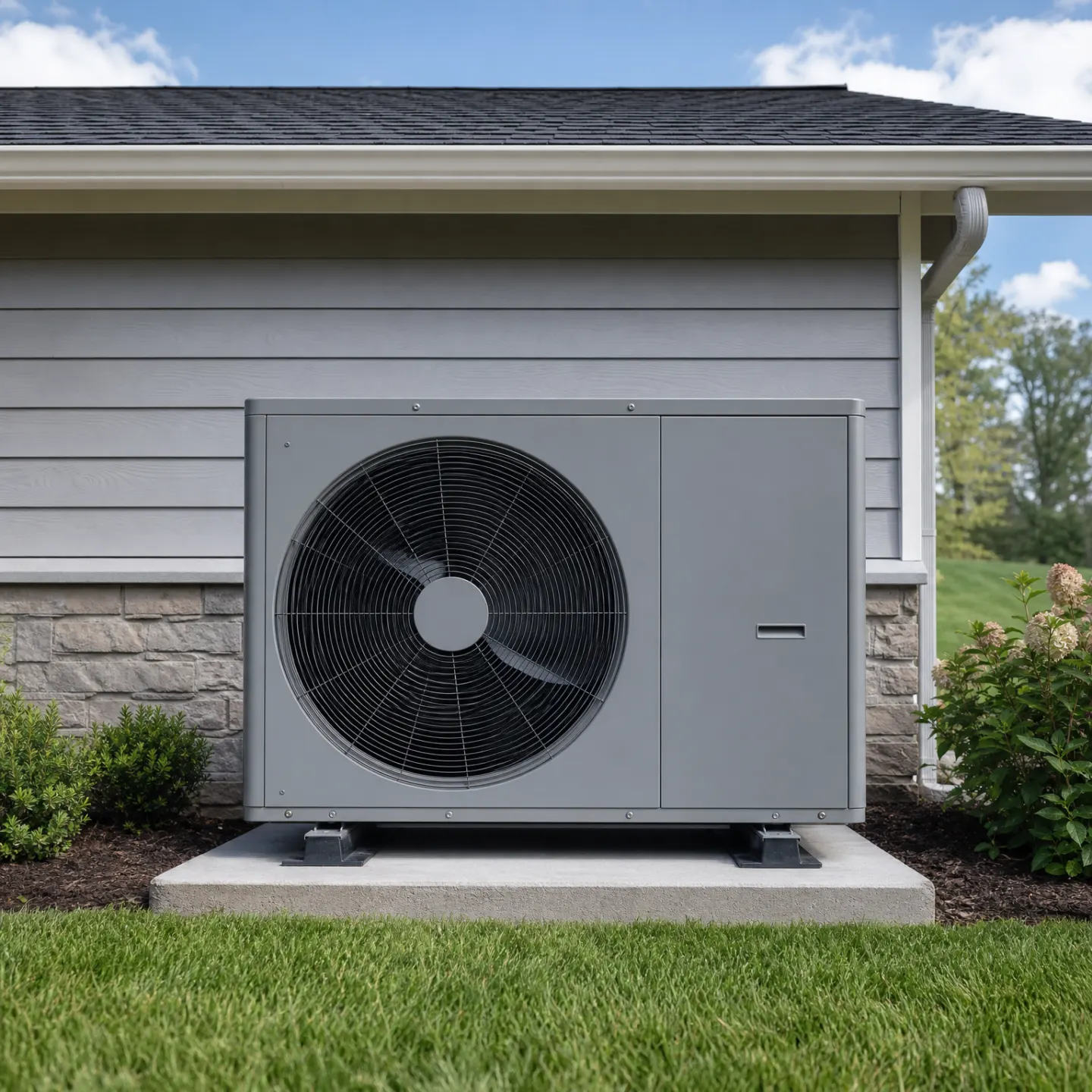
A gray outdoor HVAC unit mounted on a concrete pad beside a house with gray lap siding and a stone foundation.

What to check yourself first

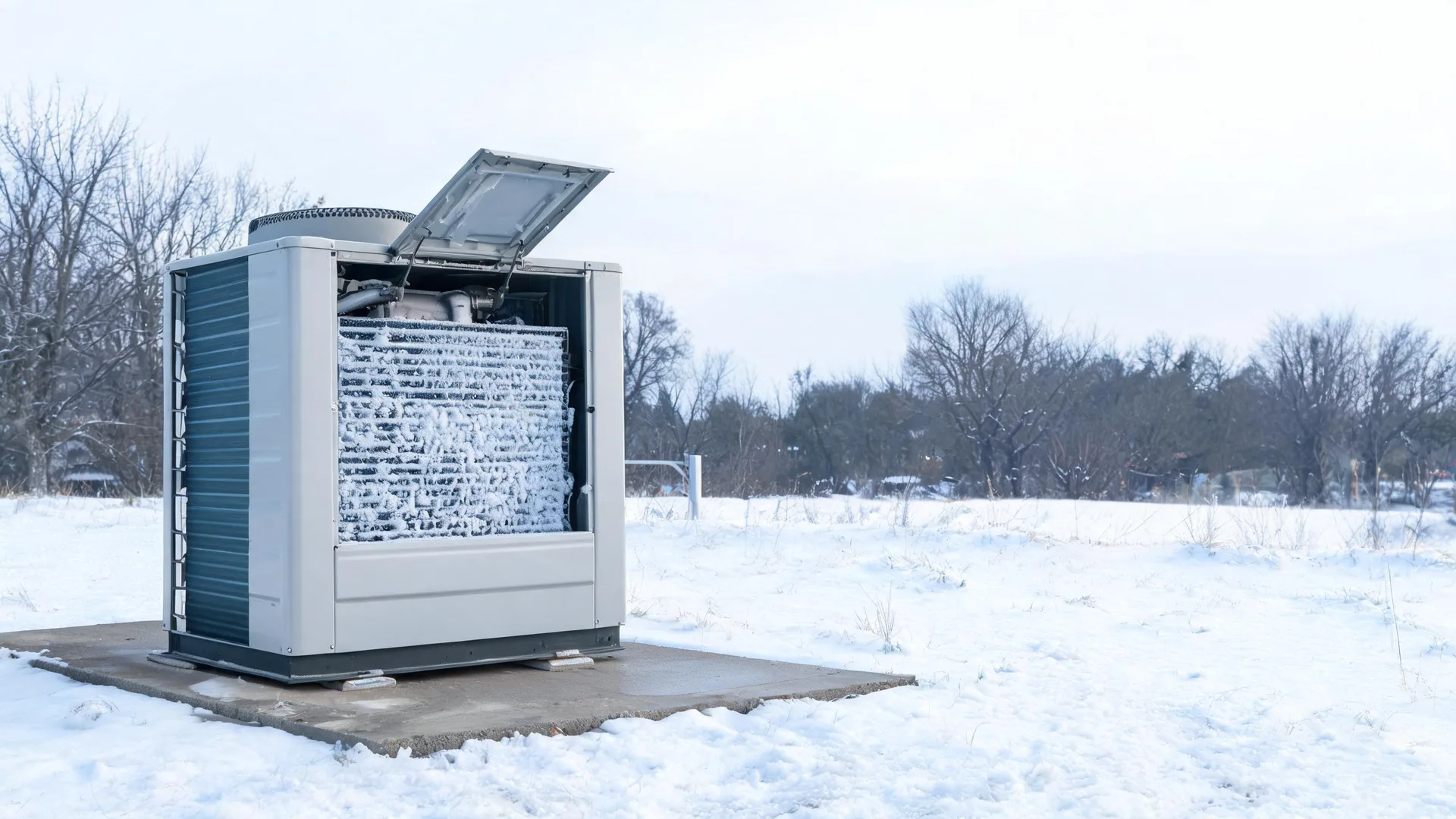
Before anyone comes out, go outside and look at the outdoor unit. Clear away anything piled against it, leaves, snow, ice, so air can move through the coil. If the fan isn't spinning and the unit is silent, check the breaker first. If it's humming but the fan won't turn, that points to the fan motor or a failed capacitor, and it's worth telling the contractor exactly that. Look at the coil itself for a heavy coat of frost or ice that doesn't clear on its own. Some frost is normal. A thick layer that stays is not. Inside, make sure the thermostat is calling for heat and set above room temperature, and swap the air filter if it's dirty. A clogged filter can make the whole system struggle to keep up. Check that vents and returns aren't blocked by furniture or rugs. If the system runs but the air coming out doesn't feel warm, don't keep it running hoping it'll catch up. That usually points to refrigerant or a part inside, not something to chase down yourself.

Most failures are electrical, not mechanical

A contactor pits from the arc every time it closes, until it sticks or stops making contact. A capacitor weakens over years until the compressor or fan motor can't get the kick it needs to start. Neither gives much warning. One day the system runs fine, the next it hums and does nothing, or doesn't respond at all.
A stuck reversing valve blows cold air, not warm

The reversing valve is what switches a heat pump between heating and cooling, and only a heat pump has one. When it sticks, the compressor can keep running while the house gets air that never warms up. That's a valve problem, not a sign the compressor itself is failing.

A heat pump in trouble usually tells you before it quits outright. Listen for the sound it makes starting up. A hard clunk, a hum that drags on too long before the compressor kicks in, or a rattle from the outdoor unit that wasn't there before all point to a part wearing out. Watch how often it cycles. Short runs that stop and start every few minutes waste the system and point to a sensor or control board issue. Watch for ice that builds up on the outdoor coil and doesn't clear during the defrost cycle, you'll see the unit run but the frost just sits there. And pay attention to air that's lukewarm instead of warm, even when the thermostat is calling for heat. Any one of these on its own is worth a call. Several together mean don't wait.

A diagnostic visit starts outside at the unit itself, checking voltage at the contactor and reading the amp draw on the compressor and fan motor against what the nameplate calls for. A gauge set goes on next to check refrigerant pressures on both the high and low side, which shows whether the charge is right and whether the reversing valve is actually switching when it's told to. Inside, a contractor checks the thermostat's call against what the air handler is actually doing, and looks at the board for a fault code if the system logs one. None of this takes long, because each reading either matches what a healthy system looks like or it doesn't. The point of the visit isn't to replace parts on a guess. It's to find the one reading that's off and let that tell you what's actually failing.