Electricity here runs 16.09 cents a kilowatt-hour
That is higher than what most US counties pay. A heat pump runs on electricity, so what you pay per kilowatt-hour sets what every hour of runtime costs you.
Takes about a minute. No obligation.
That is higher than what most US counties pay. A heat pump runs on electricity, so what you pay per kilowatt-hour sets what every hour of runtime costs you.
In Craig, the difference between a heat pump that runs efficiently and one that does not shows up on your power bill every month, not just in the summer or winter months when it works hardest.
NOAA nClimDiv, 1991–2020 normals
Winter storms hit Moffat County 191 times between 2015 and 2024.
A heat pump installed here has to hold up against that, year after year.




Moffat County sits in climate zone 6B, a cold zone with a long heating season, under the 2021 energy code. Any split-system heat pump installed here has to meet the federal minimums: at least 14.3 Btu of cooling for every watt-hour it uses over the summer, and at least 7.5 Btu of heat for every watt-hour over the winter. Those numbers apply to any system made from 2023 on, so they narrow what a contractor can put in. A unit that just clears the minimum will cost more to run through a Craig winter than one built with room above it.
A unit rated right at the federal minimum and one built with room above it cost the same to install and run differently every month after. Asking what a system is rated above that minimum, before it goes in, is what decides your power bill for as long as you own it.
Find a contractorThe compressor is the only major part in a heat pump with no season off. In a gas furnace, the burner rests most of the year. In a heat pump doing both jobs, the compressor runs through the cooling months, then carries straight into heating without a break. That steady duty cycle is normal, the equipment is built for it, but it means wear accumulates year round instead of in one season. Refrigerant charge, electrical connections and the outdoor coil all get worked on both ends of the calendar. A system that's maintained once a year, checked before the cooling months and again before the heating months, holds up to that schedule. One that only gets looked at when something already feels wrong tends to lose efficiency slowly before it ever fails outright, and that loss is easy to miss until the unit is already running harder than it should to do the same job.
Taking out a furnace or an old AC means cutting the power, capping or removing the gas line if there is one, and disconnecting the refrigerant lines and ductwork tie-ins. If the old system used refrigerant, that gets recovered into a tank rather than vented, since it's against the law to release it into the air. Once everything is disconnected, the old unit gets hauled away, and the space is left clear for what replaces it.
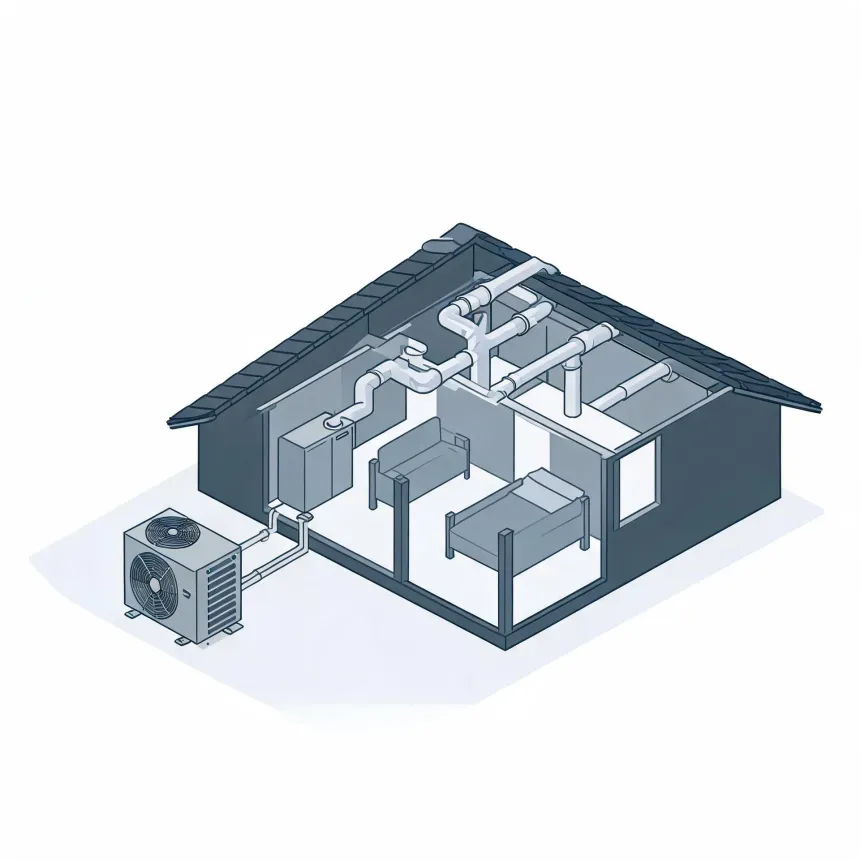
A furnace burns fuel to make heat, then pushes it through the ducts. A heat pump moves heat instead, and it runs longer at lower output to do it, so the ductwork needs to handle steady airflow rather than short hot bursts. The electrical panel also has to carry the heat pump's full load, which is usually more than the old AC alone ever drew. Checking both before the old system comes out avoids finding a mismatch after the new one is already in.
A heat pump has to be sized against the actual heat loss and heat gain of the house, room by room, not guessed from the size of the old equipment. A contractor works this out with a load calculation, weighing things like window area, insulation, ceiling height and air leakage, then matches the equipment to that number. Go too big and the unit short cycles, kicking on and off before it ever runs long enough to carry heat evenly through the house, which wears on the compressor and leaves some rooms colder than others. Go too small and it runs flat out without ever catching up on the coldest days, leaning hard on backup heat strip to make up the difference. Either mistake shows up in how the house feels and in what the unit draws to get there. The right size is the one worked out from the house itself, not picked off a price list.
Moffat County logged 191 winter storms and 82 damaging wind events between 2015 and 2024, and the outdoor unit sits through all of it. Where it goes matters. A spot clear of roof runoff and drifting snow keeps the coil from taking the worst of it, and some open space around the unit lets a contractor reach it when something needs attention. Power matters here too. A heat pump runs on electricity, and 13% of Colorado households went at least a full day without power in 2024. Gas heat without electricity still needs a working thermostat and blower, so an outage reaches further than people expect. If keeping heat or hot water through an outage matters to you, raise it with a contractor before the system goes in.